Best Boilerplates for MVP
Browse our curated selection of the best boilerplates for mvp. All listings below have been carefully selected for their exceptional quality, comprehensive features, and suitability for mvp projects. These top-rated boilerplates represent the best options available for mvp.

Shipfast
ShipFast is a full‑stack SaaS and AI boilerplate built on Next.js, designed to help developers launch web applications and subscription-based products quickly. Trusted by over 135,000 users worldwide, it has been used to generate significant revenue and has proven itself as a reliable foundation for building production-ready SaaS products. The boilerplate includes authentication, payment and subscription management via Stripe or LemonSqueezy, database integration, email workflows, multi-tenant support, and prebuilt responsive UI components, along with templates for landing pages, blogs, and marketing content. ShipFast was created by Marc Lou, a renowned indie hacker and Product Hunt award winner, who actively uses the boilerplate to build and scale his own products. Its fully structured architecture, pre-wired SaaS flows, and ready-to-deploy setup allow developers to skip repetitive boilerplate work and focus on their product’s unique features. While it is highly effective for rapid launches, one limitation is that updates are not extremely frequent, which may require manual maintenance to keep dependencies up to date. Overall, ShipFast offers a trusted, widely adopted solution for indie founders, solo developers, and small teams seeking a fast, scalable, and feature-complete boilerplate for launching SaaS or AI-powered web applications.
by Marc Lou

Supastarter
SupaStarter is a top-quality, full-featured SaaS boilerplate designed to accelerate web application development by providing a robust, production-ready foundation. Frequently updated to stay aligned with the latest technologies, SupaStarter is trusted by many successful projects and hundreds of developers worldwide. It seamlessly integrates authentication, role-based access control, team and multi-tenant management, and secure payment and subscription handling with popular providers like Stripe, Lemon Squeezy, and Polar. Supporting modern frontend frameworks such as Next.js and Nuxt 3, with TypeScript, Tailwind CSS, and Radix UI components, it delivers a responsive, customizable interface including dark mode. The backend features fully typed APIs, ORM integration with Prisma or Drizzle, background job support, cron automation, and built-in internationalization (i18n). SupaStarter also includes prebuilt landing pages, marketing pages, legal templates, and email templates, enabling developers to focus on core business logic rather than repetitive setup. With a one-time purchase and scalable architecture, SupaStarter ensures fast, maintainable, and reliable SaaS deployments for MVPs or full-scale applications.
by Jonathan Wilke

All In One Dev
AllInOneDev aims to be a “one-codebase-for-everything” template: web, iOS and Android — unifying your frontend and backend so you don’t have to build separate projects for each platform. Under the hood it uses technologies like Next.js (for web), React Native + Expo (for mobile), along with TypeScript, a monorepo via Yarn workspaces, shared UI and logic, styling via NativeWind (tailwind-style for cross-platform) and a folder structure aimed at reuse across mobile and web. The template bundles lots of common “plumbing” out of the box: user authentication (via Firebase Auth), payment integration for both web payments (via Stripe) and in-app mobile purchases/subscriptions (via RevenueCat), analytics & user-tracking, internationalization (multi-language support), push notifications, and a set of default screens/routes (onboarding, login/register, home/dashboard, profile/settings, plus landing/pricing pages for web). In practice this means if you pick AllInOneDev you get a starting point that covers almost everything non-business-specific: cross-platform UI and styling, authentication, payments, analytics, data & backend integration, navigation, and a shared codebase to reuse across web and mobile — which can save you significant development time compared to building each platform separately. However it’s important to keep things realistic. AllInOneDev is a closed (paid) boilerplate, with a license that lets you build unlimited projects personally or with a team (but doesn’t transfer ownership of the boilerplate itself) and you must respect its license terms. By using it, you also commit to its architectural choices: monorepo structure, React-Native + Next + Expo + Firebase/RevenueCat/Stripe stack, styling via NativeWind, Redux Toolkit, etc. That’s fine if you agree with those choices — but if your project needs a drastically different architecture (something more minimal, or different backend, or different payment/infrastructure stack), adapting or decoupling from AllInOneDev might get heavy. AllInOneDev is suitable if you're starting a cross-platform app (web + mobile), want to move quickly, and don’t mind leaning on a ready-made, opinionated stack so you can focus on the actual product logic. If instead you want minimal dependencies, maximum control or want to avoid vendor lock-in (Firebase, RevenueCat, etc.), then a lighter or custom solution might be more appropriate.
by Christian Esmann

Dirstarter
Dirstarter is a full-featured boilerplate built with Next.js (with TypeScript) designed for launching directory-style websites. It gives you a ready-made foundation: authentication and user management, admin panel, listing submission and management, payment integration via Stripe, and monetization options (premium listings, featured spots, ads, affiliate-links, etc.). Beyond that, Dirstarter includes SEO-friendly page structure, support for multiple languages (i18n), and built-in tools for content creation (including AI-powered content generation to help bootstrap listings and categories). On the technical side, Dirstarter leans on a modern, maintainable stack: Next.js, a modern ORM (e.g. Prisma), CSS via Tailwind CSS, and UI components from shadcn/ui / Radix UI which means you’ll get a responsive, customizable UI and a code structure that’s relatively straightforward to work with and extend. The value proposition of Dirstarter is that instead of spending weeks building the backbone of a directory site: user flows, payments, listings DB, admin UI, monetization logic, i18n, SEO - you get a working system out-of-the-box and can focus immediately on content, branding, and growth. For someone building a directory or listing-type website (local businesses, tools marketplace, niche listing directory, etc.), this can significantly reduce time to launch. However, adopting Dirstarter also means accepting its architecture and conventions. It’s opinionated: you're committing to the tech choices (Next.js + Prisma + Tailwind + the integrations Dirstarter bundles). If your project requires a drastically different backend setup, custom data models or unusual flows, you may spend extra effort altering or stripping parts you don’t need. Moreover, because it offers a lot of built-in features (payments, content generation, monetization, i18n, admin, etc.), you may end up with more “surface area” than needed which can complicate maintenance if you only need a simple directory.
by Piotr Kulpinski
KMPShip
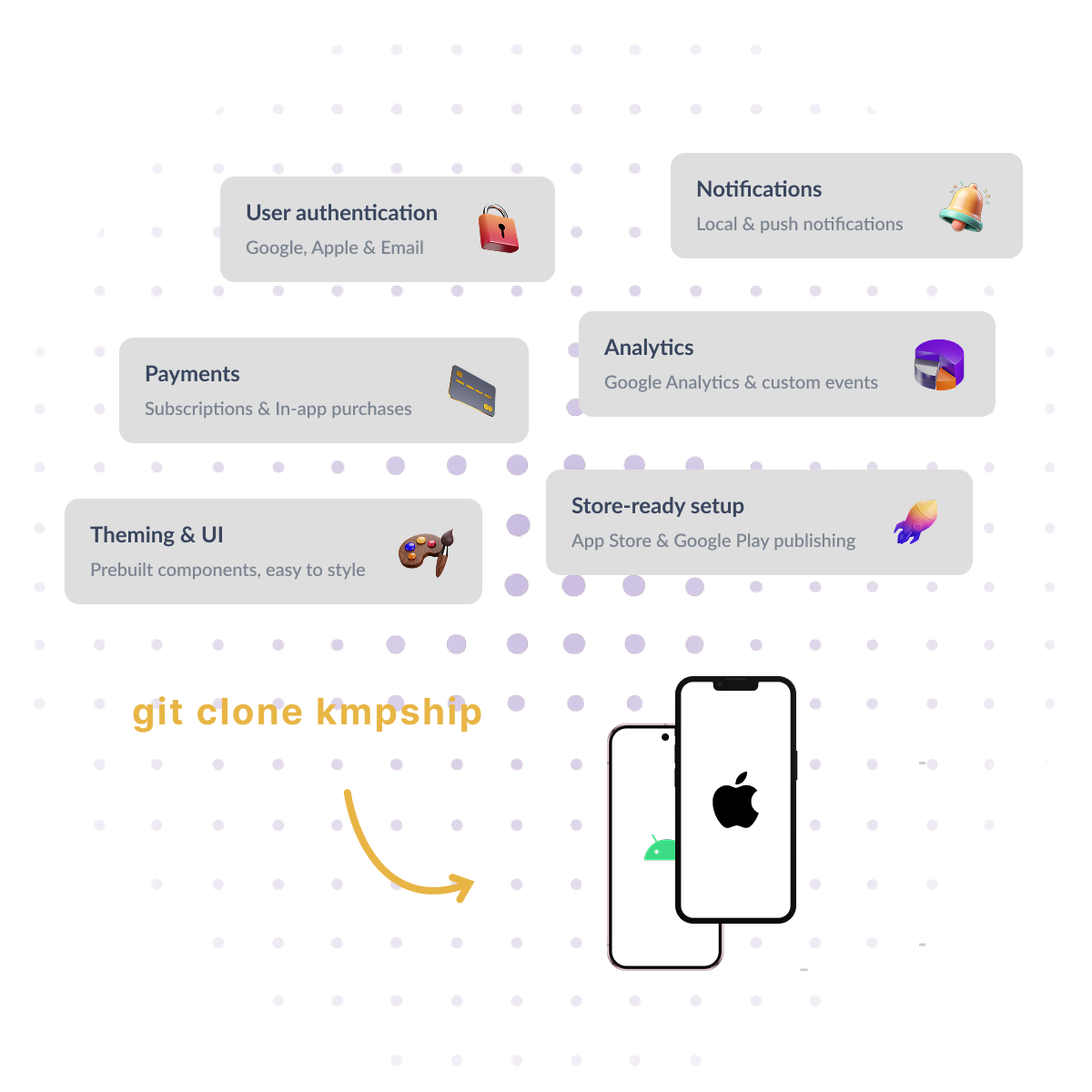
KMPShip is a production-ready boilerplate built with Kotlin & Compose Multiplatform for Android & iOS. Go from idea to App Store and Google Play in days, and start earning from day one. If you are an indie dev, freelancer, or working on your next client project, KMPShip gives you a solid foundation with everything essential already set up. Forget weeks of configuration and endless troubleshooting. With KMPShip, everything is ready out of the box: - Authentication (Google, Apple, Email/Password) - Payments with RevenueCat (In-App purchases, subscriptions and paywall) - Notifications (local & push) - CI/CD pipelines with GitHub Actions & Fastlane - Clean architecture, offline mode, dark mode - Sample app and documentation - Access to a private Discord community Recognized by leading platforms: KMPShip is already gaining recognition from leading startup communities and developer platforms, trusted by indie makers and freelancers worldwide. Start building apps faster and turn your ideas into income today.
by Vivien Mahé
Makerkit
MakerKit is a SaaS‑starter boilerplate built for modern React/Next.js (also supporting Remix/Supabase or Firebase variants) that tries to give you a production‑ready foundation, rather than a barebones template. At its core MakerKit bundles authentication (email, social login, magic‑link, optional MFA), user and team/organization management (multi‑tenancy, roles, invitations), and subscription/billing support via payment providers (Stripe or Lemon Squeezy). The boilerplate comes styled by default using a modern UI stack with Tailwind CSS (and Shadcn/Radix‑based UI components), with light/dark mode and includes UI scaffolding for dashboards, admin panels, marketing pages, blog/documentation pages, and a customizable layout structure. MakerKit aims to reduce the time and effort needed to ship a SaaS: instead of wiring up auth, payments, data layer, UI and common SaaS flows from scratch, you get a working skeleton that you can extend, customize, and build on. This includes also support for serverless or traditional hosting setups, built‑in support for sending stylized transactional emails, and optional plugins/features (like documentation/blog generation, admin dashboards, analytics hooks, and more) to help bootstrap both the product and its public-facing/marketing side.
by Giancarlo Buomprisco
Mobile & Web App Starter kit
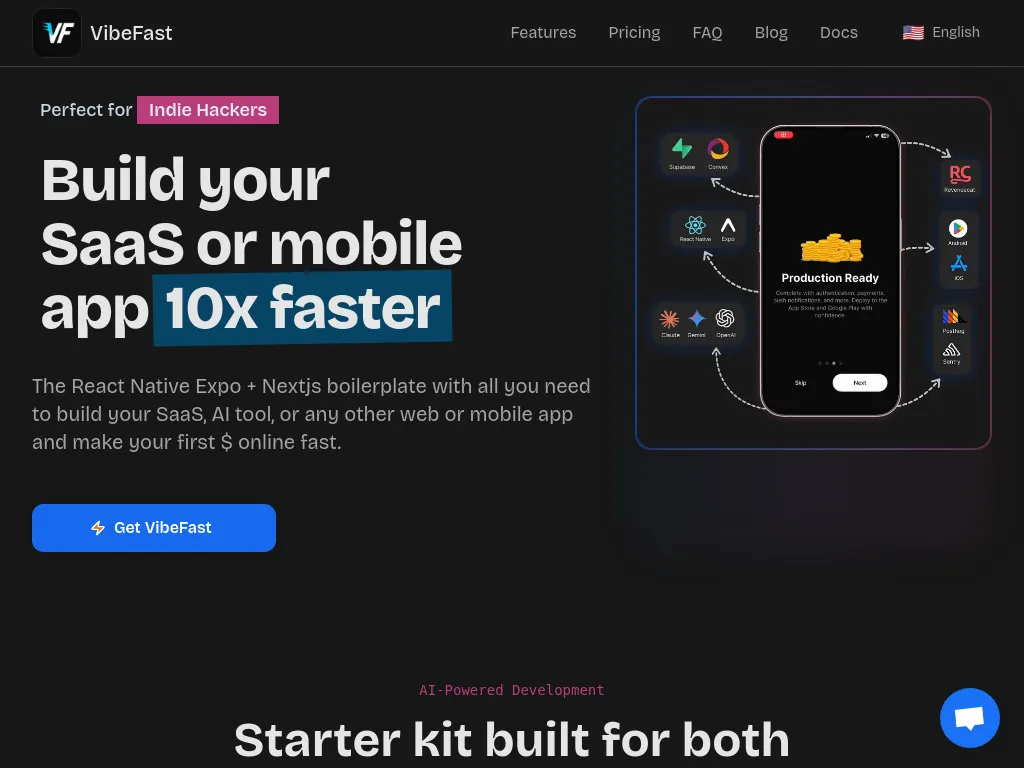
VibeFast is a Expo + Next.js + Convex/Supabase starter kit that handles the repetitive setup so you can focus on building the fun parts and drastically cut down development time. It has a CLI, with which you can literally chose the features you need, so your codebase stays clean, and add/remove features anytime. 🧰 What’s inside: ⚙️ Convex/Supabase realtime backend 🔐 Auth (email/OAuth/Guest) 💸 RevenueCat subscriptions/paywall 🤖 AI chatbot, voicebot & wake-word 🖼️ AI Image generation + AI Image analysis 📊 Multiple Charts 🧭 Onboarding + quiz flow 🔔 Push notifications 📱 iOS widget + quick actions 📄 Next.js landing pages + admin + Payments 🛠️ Sentry + PostHog built in Everything lives in one clean monorepo.
Nextbase
NextBase is a Next.js + Supabase full‑stack SaaS starter kit. It combines authentication (with multiple social login providers), team/organization support, subscription payments (Stripe or LemonSqueezy), a prebuilt admin panel and user‑management UI, database & backend setup, and a frontend built with React, Typescript, and Tailwind CSS. On top of that, NextBase includes extras like a MDX‑based blog/docs/landing‑page system, feedback & roadmap/changelog tools, in‑app notifications, and integrations for analytics & error tracking. The architecture is type-safe, modern (React + Next.js app‑router, Supabase backend, TS + Zod validation), and built to support both MVPs and production-ready SaaS products.
by Bhargav Ponnapalli
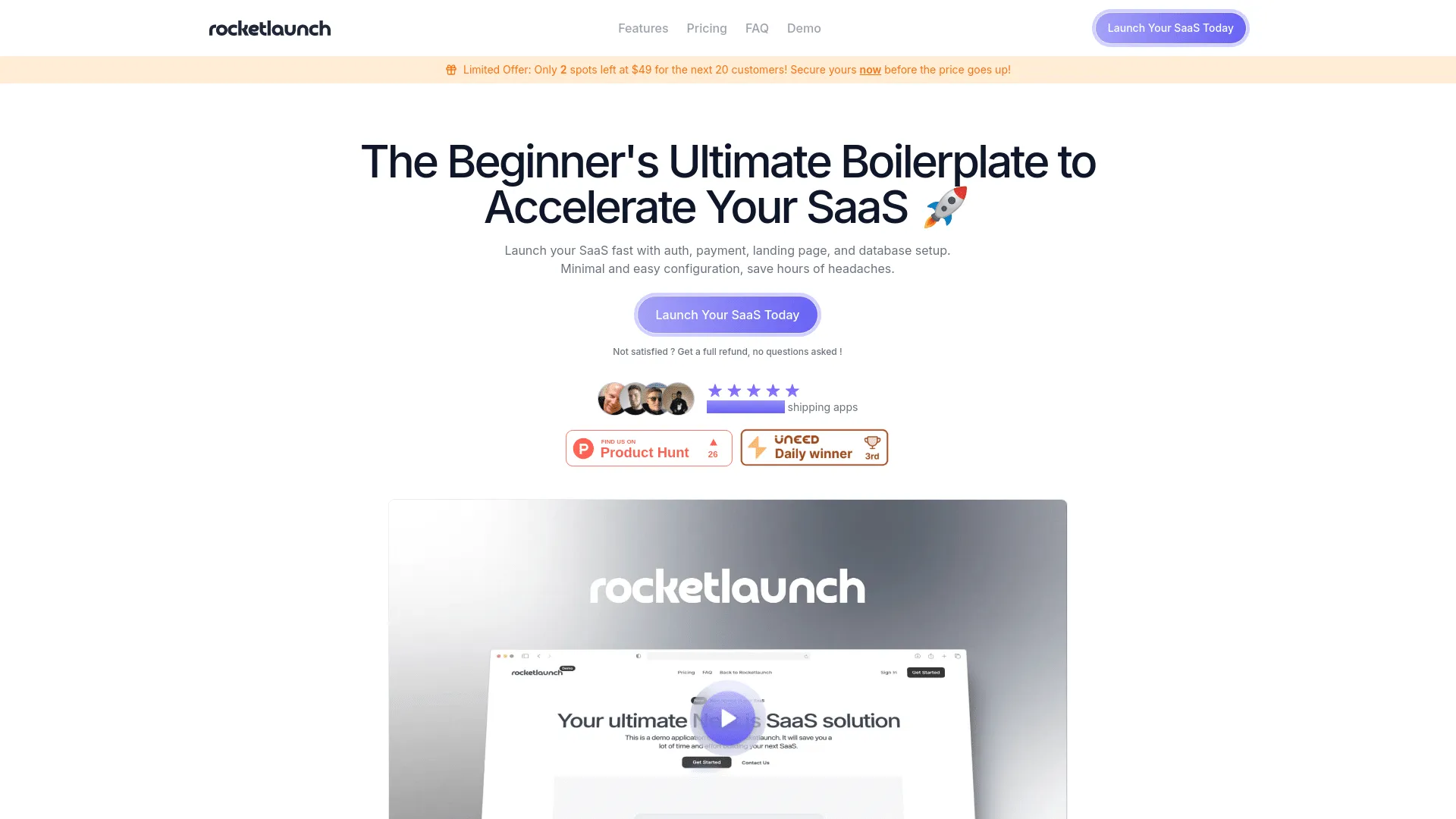
Rocket Launch
Rocketlaunch is a paid SaaS boilerplate built on Next.js + TypeScript + modern web tools. It aims to help developers launch a full SaaS‑style application quickly by providing a pre‑wired foundation covering many of the repetitive parts most apps share. With Rocketlaunch you receive user authentication (via Clerk including email/password, social login, magic‑link, and full user management), subscription and payment support (via Stripe both one‑time and recurring), a backend + database setup (with Prisma + Supabase), and a ready‑to‑use frontend & UI system built with Tailwind CSS and modern UI components. You also get a landing‑page template (for marketing or public presence), account management pages, protected API routes, and a structure that handles many typical SaaS flows authentication, paid subscriptions, user data, and database interactions. The license allows using the boilerplate code for unlimited projects once purchased. Choosing Rocketlaunch means working within its tech stack and architectural decisions: Next.js, Clerk for auth, Supabase/Prisma for database, Stripe for billing, and the provided UI/layout/components system. That makes initial setup faster and removes repetitive boilerplate but also ties you to those tools and decisions, which may limit flexibility if you later want to swap major components. The codebase is more opinionated and potentially heavier than a minimal starter template great for full‑featured SaaS apps, but possibly overkill for simpler projects, prototypes or highly customized apps.
by Samuel Benhamou

ShipAhead
The NuxtJS boilerplate to ship your SaaS, AI tool, or your next big app. ShipAhead is a Nuxt boilerplate designed to accelerate the development of AI SaaS applications. It provides pre-built features like authentication, payments, internationalization, and security, allowing developers to focus on core product functionality rather than repetitive setup tasks. Key Features: - Authentication: Email/password, magic links, and OAuth (Google, GitHub) support. - Backend: Drizzle ORM, Postgres, Cloudflare R2/AWS S3 storage, admin dashboard, user management, and cron jobs. - Payments: Stripe/Polar/Dodo Payments integration with checkout flows, subscriptions, and multi-currency support. - Frontend & UI: Nuxt, Vue, Tailwind CSS, and daisyUI for responsive design and pre-built UI components. - Internationalization: Multi-language support with Vue i18n. - Security: Cloudflare Turnstile for captcha and Redis for rate limiting. - Email: Transactional emails with pre-built templates using Resend. - SEO: Optimized SEO setup with Nuxt SEO. - PWA: Progressive Web App support for installable apps. - AI Integration: OpenRouter integration for AI features. - Customer Support: Built-in live chat and support widget. - Others: Code templates, tutorials, legal page prompts, and Cursor/Windsurf integration. Use Cases: - Rapid prototyping of SaaS applications. - Building AI-powered tools and services. - Creating platforms with user authentication and subscription models. - Developing internationalized applications with multi-language support.
by Tom Han
What Boilerplate is Best for MVP?
Determining which boilerplate is best for your mvp project is not a question with a one-size-fits-all answer. The "best" boilerplate depends on your specific needs, budget, technical requirements, and project goals. What works perfectly for one mvp might not be the ideal choice for another.
Different boilerplates excel in different areas. Some prioritize comprehensive features and extensive functionality, while others focus on simplicity and ease of use. Some offer better documentation and support, while others provide more flexibility for customization. The best choice depends on factors like your development experience, timeline, budget, and specific feature requirements.
To help you make an informed decision, we've prepared a comprehensive comparison table below that highlights the key features of each top-rated boilerplate for mvp. This comparison allows you to quickly see which boilerplates include the features most important to your project, making it easier to identify the best option for your specific needs.
| Feature | ||||||||||
|---|---|---|---|---|---|---|---|---|---|---|
| Authentication | ✓ | ✓ | — | ✓ | ✓ | ✓ | ✓ | ✓ | ✓ | ✓ |
| Stripe | ✓ | ✓ | — | ✓ | — | ✓ | ✓ | ✓ | ✓ | ✓ |
| Admin Panel | — | — | — | ✓ | — | ✓ | ✓ | ✓ | ✓ | ✓ |
| User Dashboard | — | ✓ | — | ✓ | — | ✓ | ✓ | ✓ | ✓ | ✓ |
| Subscriptions | ✓ | ✓ | — | ✓ | ✓ | ✓ | ✓ | ✓ | ✓ | ✓ |
| Blog | ✓ | ✓ | — | ✓ | — | ✓ | ✓ | ✓ | — | ✓ |
| SEO | ✓ | ✓ | — | ✓ | — | ✓ | ✓ | ✓ | ✓ | ✓ |
| Documentation | ✓ | ✓ | — | ✓ | ✓ | ✓ | ✓ | ✓ | ✓ | ✓ |
| Support | ✓ | ✓ | — | ✓ | ✓ | ✓ | — | ✓ | — | ✓ |
| Tailwind CSS | — | ✓ | — | ✓ | — | ✓ | ✓ | — | ✓ | ✓ |
| API | — | ✓ | — | — | — | — | — | — | — | ✓ |
| Actions | Visit Website | Visit Website | Visit Website | Visit Website | Visit Website | Visit Website | Visit Website | Visit Website | Visit Website | Visit Website |
Use this comparison table to identify which boilerplate for mvp includes the features most important to your project. Click on any boilerplate name above to view detailed information and make your final decision.
Why Use the Best Boilerplates for MVP?
The best boilerplates for MVPs provide a rapid way to validate your business idea without investing months in development. MVPs need to be built quickly and cost-effectively, and boilerplates give you production-ready infrastructure from day one. They include essential features like authentication, basic payments, and user management—everything you need to launch and test your concept. Many successful products started as MVPs built on boilerplates, proving they're an excellent choice for validating ideas before investing in custom development.
For a comprehensive comparison of all top-rated boilerplates, visit our best boilerplates directory.
What to Look For in the Best Boilerplates for MVP
When choosing the best boilerplate for your MVP, prioritize simplicity, essential features, and ease of setup. Look for boilerplates with authentication, basic payment processing, user dashboard, and good documentation. The best MVP boilerplates are well-documented, easy to customize, and don't include unnecessary complexity. Consider free or cheap options ($50 or less) for MVPs, as you may pivot or rebuild based on validation results.
Getting Started with the Best Boilerplates for MVP
To get started with the best MVP boilerplate, choose a free or affordable option, download the template, set up your development environment, install dependencies, and configure basic settings. Most MVP boilerplates include simple setup instructions. You'll need to configure authentication, set up a basic payment processor if needed, and customize the branding. The goal is to launch quickly, so focus on essential customization only. Once your MVP is live, gather user feedback and iterate based on what you learn.
Benefits of the Best Boilerplates for MVP
- ✓Rapid validation - Launch your MVP in days or weeks
- ✓Low cost - Free or affordable options available
- ✓Essential features - Everything needed to test your idea
- ✓Quick setup - Get running in hours, not months
- ✓Flexibility - Easy to customize or pivot based on feedback
- ✓Time savings - Focus on validation, not infrastructure
- ✓Production-ready - Built with best practices
- ✓Easy to iterate - Modify quickly based on user feedback
Key Features in the Best Boilerplates for MVP
Frequently Asked Questions About Best Boilerplates for MVP
What's the difference between an MVP boilerplate and a full SaaS boilerplate?
MVP boilerplates focus on essential features needed to validate an idea quickly, while full SaaS boilerplates include comprehensive features for production products. MVP boilerplates are simpler, faster to set up, and often cheaper. They're perfect for testing concepts, while full SaaS boilerplates are better for products ready to scale.
Should I use a free or paid boilerplate for my MVP?
For MVPs, free or cheap boilerplates (under $50) are often sufficient. They provide essential features needed for validation without a large upfront investment. If your MVP validates and you decide to scale, you can then invest in a more comprehensive paid boilerplate or custom development.
How quickly can I launch an MVP with a boilerplate?
With a quality MVP boilerplate, you can launch in days or weeks. Basic setup typically takes 1-4 hours, while minimal customization and branding might take 1-3 days. The goal is speed, so focus on essential features only and iterate based on user feedback after launch.
Can I scale an MVP built on a boilerplate?
Yes, many successful products started as MVPs built on boilerplates and scaled to full production. However, you may need to refactor or migrate to a more comprehensive solution as you grow. The boilerplate gives you a solid foundation that can be extended or replaced as your product evolves.