
Best React.js Boilerplates
Browse our curated selection of the best React.js boilerplates. All listings below have been carefully selected for their exceptional quality, comprehensive features, and outstanding value. These top-rated boilerplates represent the cream of the crop in the React.js ecosystem.

Shipfast
ShipFast is a full‑stack SaaS and AI boilerplate built on Next.js, designed to help developers launch web applications and subscription-based products quickly. Trusted by over 135,000 users worldwide, it has been used to generate significant revenue and has proven itself as a reliable foundation for building production-ready SaaS products. The boilerplate includes authentication, payment and subscription management via Stripe or LemonSqueezy, database integration, email workflows, multi-tenant support, and prebuilt responsive UI components, along with templates for landing pages, blogs, and marketing content. ShipFast was created by Marc Lou, a renowned indie hacker and Product Hunt award winner, who actively uses the boilerplate to build and scale his own products. Its fully structured architecture, pre-wired SaaS flows, and ready-to-deploy setup allow developers to skip repetitive boilerplate work and focus on their product’s unique features. While it is highly effective for rapid launches, one limitation is that updates are not extremely frequent, which may require manual maintenance to keep dependencies up to date. Overall, ShipFast offers a trusted, widely adopted solution for indie founders, solo developers, and small teams seeking a fast, scalable, and feature-complete boilerplate for launching SaaS or AI-powered web applications.
by Marc Lou

Dirstarter
Dirstarter is a full-featured boilerplate built with Next.js (with TypeScript) designed for launching directory-style websites. It gives you a ready-made foundation: authentication and user management, admin panel, listing submission and management, payment integration via Stripe, and monetization options (premium listings, featured spots, ads, affiliate-links, etc.). Beyond that, Dirstarter includes SEO-friendly page structure, support for multiple languages (i18n), and built-in tools for content creation (including AI-powered content generation to help bootstrap listings and categories). On the technical side, Dirstarter leans on a modern, maintainable stack: Next.js, a modern ORM (e.g. Prisma), CSS via Tailwind CSS, and UI components from shadcn/ui / Radix UI which means you’ll get a responsive, customizable UI and a code structure that’s relatively straightforward to work with and extend. The value proposition of Dirstarter is that instead of spending weeks building the backbone of a directory site: user flows, payments, listings DB, admin UI, monetization logic, i18n, SEO - you get a working system out-of-the-box and can focus immediately on content, branding, and growth. For someone building a directory or listing-type website (local businesses, tools marketplace, niche listing directory, etc.), this can significantly reduce time to launch. However, adopting Dirstarter also means accepting its architecture and conventions. It’s opinionated: you're committing to the tech choices (Next.js + Prisma + Tailwind + the integrations Dirstarter bundles). If your project requires a drastically different backend setup, custom data models or unusual flows, you may spend extra effort altering or stripping parts you don’t need. Moreover, because it offers a lot of built-in features (payments, content generation, monetization, i18n, admin, etc.), you may end up with more “surface area” than needed which can complicate maintenance if you only need a simple directory.
by Piotr Kulpinski
Makerkit
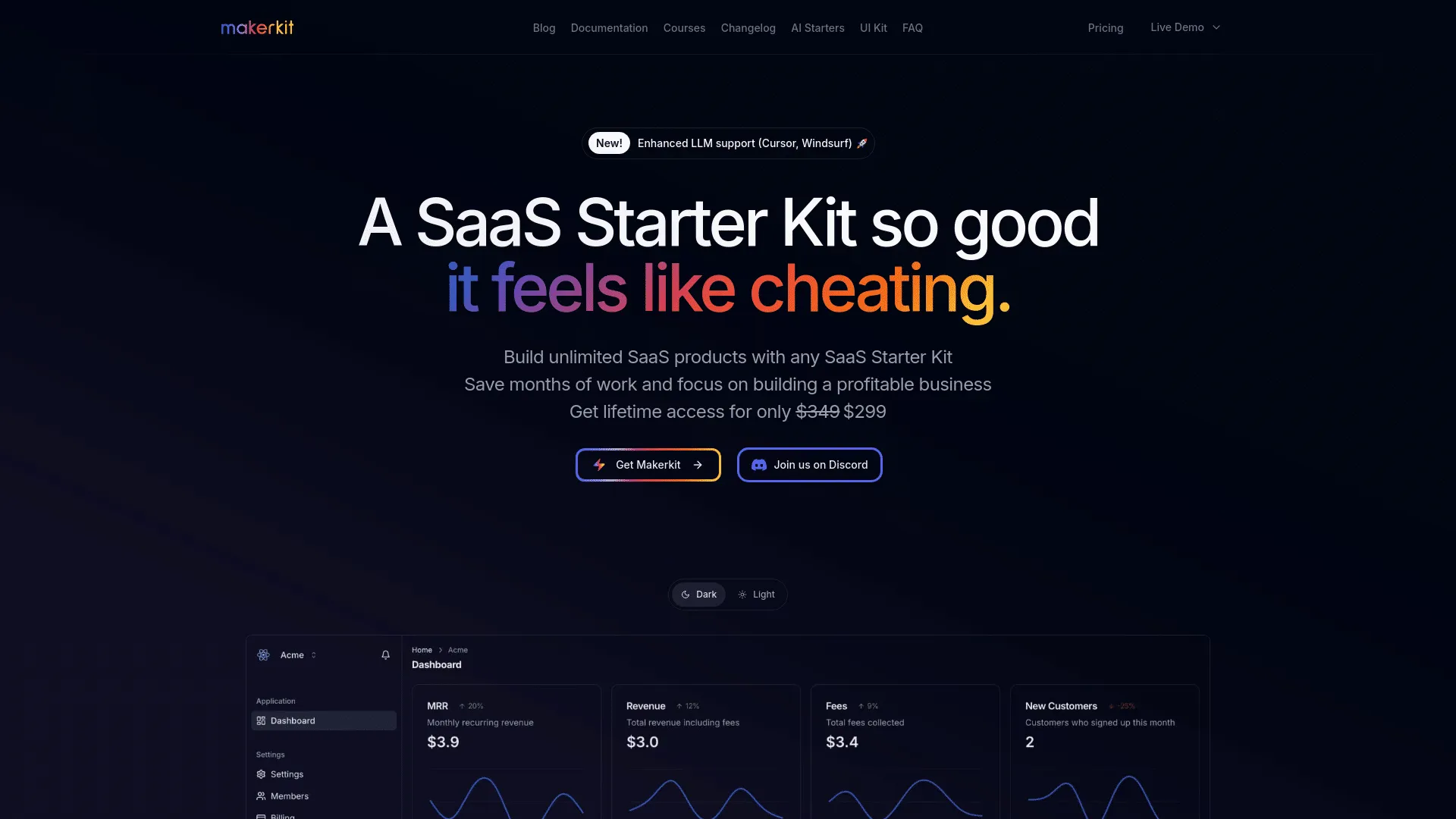
MakerKit is a SaaS‑starter boilerplate built for modern React/Next.js (also supporting Remix/Supabase or Firebase variants) that tries to give you a production‑ready foundation, rather than a barebones template. At its core MakerKit bundles authentication (email, social login, magic‑link, optional MFA), user and team/organization management (multi‑tenancy, roles, invitations), and subscription/billing support via payment providers (Stripe or Lemon Squeezy). The boilerplate comes styled by default using a modern UI stack with Tailwind CSS (and Shadcn/Radix‑based UI components), with light/dark mode and includes UI scaffolding for dashboards, admin panels, marketing pages, blog/documentation pages, and a customizable layout structure. MakerKit aims to reduce the time and effort needed to ship a SaaS: instead of wiring up auth, payments, data layer, UI and common SaaS flows from scratch, you get a working skeleton that you can extend, customize, and build on. This includes also support for serverless or traditional hosting setups, built‑in support for sending stylized transactional emails, and optional plugins/features (like documentation/blog generation, admin dashboards, analytics hooks, and more) to help bootstrap both the product and its public-facing/marketing side.
by Giancarlo Buomprisco
What React.js Boilerplate is Best?
Determining which React.js boilerplate is best for your project is not a question with a one-size-fits-all answer. The "best" boilerplate depends on your specific needs, budget, technical requirements, and project goals. What works perfectly for one developer or startup might not be the ideal choice for another.
Different React.js boilerplates excel in different areas. Some prioritize comprehensive features and extensive functionality, while others focus on simplicity and ease of use. Some offer premium support and detailed documentation, while others provide more flexibility for customization. The best choice depends on factors like your development experience, timeline, budget, and specific feature requirements.
To help you make an informed decision, we've prepared a comprehensive comparison table below that highlights the key features of each top-rated React.js boilerplate. This comparison allows you to quickly see which boilerplates include the features most important to your project, making it easier to identify the best option for your specific needs.
| Feature | |||
|---|---|---|---|
| Authentication | ✓ | ✓ | ✓ |
| Stripe | ✓ | ✓ | ✓ |
| Admin Panel | — | ✓ | ✓ |
| User Dashboard | — | ✓ | ✓ |
| Subscriptions | ✓ | ✓ | ✓ |
| Blog | ✓ | ✓ | ✓ |
| SEO | ✓ | ✓ | ✓ |
| Documentation | ✓ | ✓ | ✓ |
| Support | ✓ | ✓ | ✓ |
| Tailwind CSS | — | ✓ | ✓ |
| API | — | — | — |
| CMS | ✓ | ✓ | ✓ |
| Actions | Visit Website | Visit Website | Visit Website |
Use this comparison table to identify which React.js boilerplate includes the features most important to your project. Click on any boilerplate name above to view detailed information and make your final decision.
Why Use the Best React.js Boilerplates?
The best React.js boilerplates provide a powerful foundation for building modern SaaS applications with the world's most popular JavaScript library. These carefully selected boilerplates offer comprehensive features like routing, state management, authentication, UI components, and more, allowing you to focus on building unique features rather than setting up infrastructure. Whether you're building a single-page application, dashboard, or complex SaaS product, the best React boilerplates give you a production-ready foundation that accelerates development.
If you're looking for all React.js boilerplates, including free and paid options, check out our complete React.js boilerplates directory.
What to Look For in the Best React.js Boilerplates
When selecting the best React.js boilerplate, prioritize projects with React 18+, TypeScript support, modern state management (Redux Toolkit, Zustand, or Context API), routing (React Router), comprehensive authentication, UI component library (Material-UI, Chakra UI, or Tailwind CSS), and excellent documentation. The best React boilerplates also include build configuration, testing setup, API integration, and deployment guides. Look for active maintenance, regular updates, and positive user reviews.
For a comprehensive comparison of all top-rated boilerplates across different frameworks, visit our best boilerplates directory.
Getting Started with the Best React.js Boilerplates
To start with the best React.js boilerplate, purchase and download the template, install dependencies, configure environment variables, set up your API endpoints, and start the development server. Most best React boilerplates include setup documentation and example configurations. You'll need to configure authentication, API connections, and customize the UI to match your brand. Once configured, build for production and deploy to platforms like Netlify, Vercel, or AWS.
Benefits of the Best React.js Boilerplates
- ✓Component-based architecture - Build reusable, maintainable UI components
- ✓Large ecosystem - Access to thousands of React libraries and tools
- ✓Developer experience - Excellent tooling and debugging capabilities
- ✓Flexibility - Use with any backend or API
- ✓Community support - Massive community and extensive resources
- ✓Production-ready - Battle-tested patterns and best practices
- ✓Comprehensive features - Everything you need to launch a SaaS product
- ✓Active maintenance - Regular updates and security patches
Common Features in the Best React.js Boilerplates
Frequently Asked Questions About Best React.js Boilerplates
What is the best React.js boilerplate for SaaS?
The best React.js boilerplate for SaaS depends on your specific needs, but top choices typically include comprehensive authentication, payment processing (Stripe or Paddle), admin panels, user dashboards, and subscription management. Look for boilerplates with production-ready code, active maintenance, good documentation, and features that match your project requirements. Compare the listings above to find one that fits your budget and technical needs.
How much time can a React.js boilerplate save me?
A quality React.js boilerplate can save you 2-6 months of development time. Instead of building authentication, payment systems, admin panels, email functionality, and database schemas from scratch, you get these features pre-built and tested. This lets you focus on your unique business logic and ship your product faster. Many developers report launching their MVPs in weeks instead of months.
Are React.js boilerplates worth the cost?
Yes, React.js boilerplates are typically worth the investment. If you value your development time at $50-100/hour, a boilerplate that saves you 200+ hours of work pays for itself many times over. Beyond time savings, you get tested code, best practices, security features, and ongoing updates. Most successful SaaS founders consider boilerplates one of their best early investments.
Can I use a React.js boilerplate for commercial projects?
Yes, most React.js boilerplates allow commercial use. They typically include licenses that permit building and selling products using the boilerplate code. However, always check the specific license terms before purchasing. Most use single-project or unlimited-project licenses, and some offer source code that you can modify freely for your commercial SaaS products.
What features should the best React.js boilerplate include?
The best React.js boilerplates should include: authentication (email/password, OAuth, magic links), payment processing (Stripe, Paddle, or similar), database integration, admin panel, user dashboard, email system, subscription management, role-based access control, API endpoints, and responsive UI. Premium boilerplates often add features like multi-tenancy, team management, analytics, and advanced integrations.
How do I choose between different React.js boilerplates?
Compare boilerplates based on: included features, documentation quality, update frequency, support responsiveness, tech stack compatibility, pricing, user reviews, and demo availability. Use the comparison table above to evaluate features side-by-side. Consider whether you need specific integrations (payment processors, email providers, hosting platforms) and check if the boilerplate supports them. Read reviews and check for active maintenance before purchasing.
Do React.js boilerplates include updates and support?
Most React.js boilerplates include updates for bug fixes and security patches. Premium boilerplates often offer lifetime updates with new features added regularly. Support varies by product—expect email support, documentation, and community access as standard. Premium options may include priority support, private Discord channels, or direct messaging with the creator. Always check the specific support terms before purchase.
Can I customize a React.js boilerplate for my specific needs?
Yes, React.js boilerplates are designed to be fully customizable. You get access to all source code, allowing you to modify features, add new functionality, change the UI/UX, integrate additional services, and adapt the code to your specific requirements. The best boilerplates are built with extensibility in mind, making customization straightforward even for developers new to React.js.
Are there free React.js boilerplates available?
Yes, there are free React.js boilerplates available, though they typically offer fewer features and less support than paid options. Free boilerplates are great for learning, prototyping, or small projects, but paid boilerplates usually provide more comprehensive features, better documentation, active support, and regular updates. For serious SaaS projects, investing in a quality paid boilerplate often saves time and headaches in the long run.
How quickly can I launch with a React.js boilerplate?
With a React.js boilerplate, you can launch an MVP in 1-4 weeks instead of 2-6 months building from scratch. Setup typically takes a few hours, then you focus on customizing the UI, adding your unique features, and configuring integrations. The exact timeline depends on your experience level, the complexity of your product, and how much customization you need. Many founders ship their first version within days of purchasing a boilerplate.
What's the difference between a React.js boilerplate and a template?
A React.js boilerplate includes full backend functionality (authentication, database, APIs, payment processing), while templates typically focus only on UI/frontend design. Boilerplates provide complete, production-ready applications with working features, whereas templates offer design starting points that you'll need to connect to backend services. For building a SaaS product, you want a full-featured boilerplate, not just a visual template.